.png)


About Instrumentl
Instrumentl is an AI-native grants management platform that helps nonprofits manage the full grant lifecycle in one place, from discovery to post-award.
By combining automation and AI-driven recommendations, the platform reduces manual work, improves visibility, and enables teams to manage grants more efficiently and consistently.
Since 2015, Instrumentl has supported 5,000+ nonprofits, connecting them to a broad funding ecosystem of 400,000+ funders and 30,000+ curated grant opportunities to drive more informed, data-driven funding decisions.

Initial Scenario: Analytics Maturity & Organizational Context
Before adopting Omni, Instrumentl didn’t have a centralized BI platform.
Analytics relied on a mix of internal and external tools, with significant manual effort in between. Reports were exported from multiple systems, consolidated in Google Sheets, and manually cleaned, joined, and analyzed. While workable in the short term, this approach became increasingly time-consuming and difficult to scale as both the company and its data needs grew.
We reached a point where we had to adopt a BI tool. Our existing processes were slow and highly decentralized. Data wasn’t automatically refreshing, and we spent a lot of time manually exporting and moving data between systems. — Zach Sugano, Senior Software Engineer
Over time, several challenges began to limit scalability and efficiency:
- Data analysis required a lot of manual intervention across tools
- Reporting logic was built in isolation, with little reuse across teams
- Metric definitions weren't consistent across reports & stakeholders
- Data access was limited to technical experts
- Engineers became a bottleneck for ad-hoc data requests
- Visualizations, alerting, and monitoring were limited and unintuitive
Beyond the challenges mentioned, the team was increasingly eager to leverage AI to improve data access across the business, but didn't have much time to focus on a complex setup.
As a result, adopting an analytics platform became essential to support scalable operations, ensure metrics consistency, and enable self-service across the organization.
Selecting the Right Analytics Tool for Business Needs
The first step in selecting an analytics platform was establishing a clear understanding of business needs. This allowed Instrumentl to define objectives, evaluation criteria, and success metrics for its first analytics foundation, including:
- Centralize data access in a single, easy-to-use location
- Reduce time & effort for recurring reports (e.g. weekly ARR reporting)
- Eliminate inconsistencies across data definitions
- Enable self-serve data exploration for non-technical users
- Integration with existing tech stack (Google Cloud BigQuery, dbt, Dagster, GitHub)
- Flexibility data modeling and exploration
- Version control and development workflow support
- Visualization capabilities and customization options
- AI/LLM capabilities for natural-language data querying
The team evaluated several tools, including Looker, Sigma, Hex, and Omni.
As a startup with limited data engineering and analytics capacity, Instrumentl needed a solution that could serve multiple user personas without introducing heavy operational overhead.
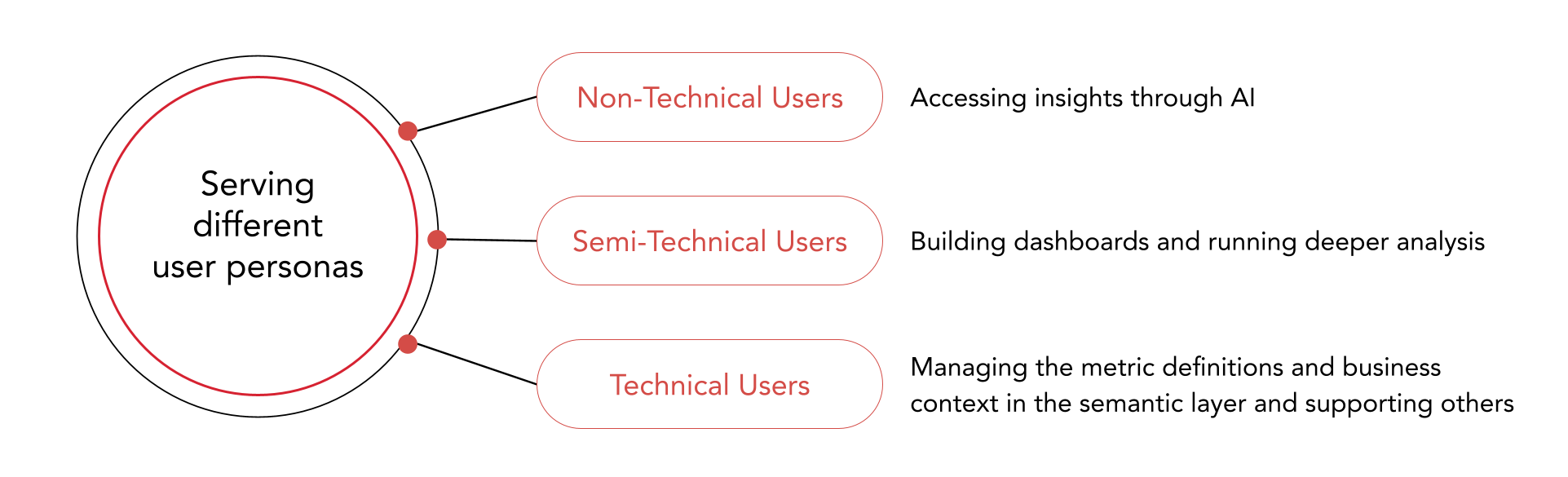
Omni stood out for meeting all their key criteria and supporting each group of users, without forcing a rigid workflow.
During our evaluation, we found that many other tools were heavily optimized for just one of those personas. — Zach Sugano, Senior Software Engineer
Additional factors that strengthened Omni’s position included its flexible semantic layer, which allows the data team to define metrics for reuse and capture context from experts across the business, while still enabling ad-hoc exploration of new data.
Omni’s bi-directional dbt integration also stood out for its ability to streamline workflows and sync context across platforms. This allowed Instrumentl to establish strong governance incrementally, while still giving teams flexibility to move fast.
In addition, Omni reuses that same logic and context from the semantic layer for AI queries, which enabled the team to get started quickly and build out advanced use cases over time.
Implementation & Onboarding Support
The implementation took approximately three months, with onboarding jointly supported by Omni and Shearwater.
As part of the implementation process, Omni provided a structured onboarding program with specialized, fast, and highly collaborative support called a “Quick Start”. This includes a dedicated Slack channel with near real-time responses, as well as live training sessions.
Trainings were tailored by user profile — developers and creators — enabling power users to build content independently and scale knowledge across the organization.
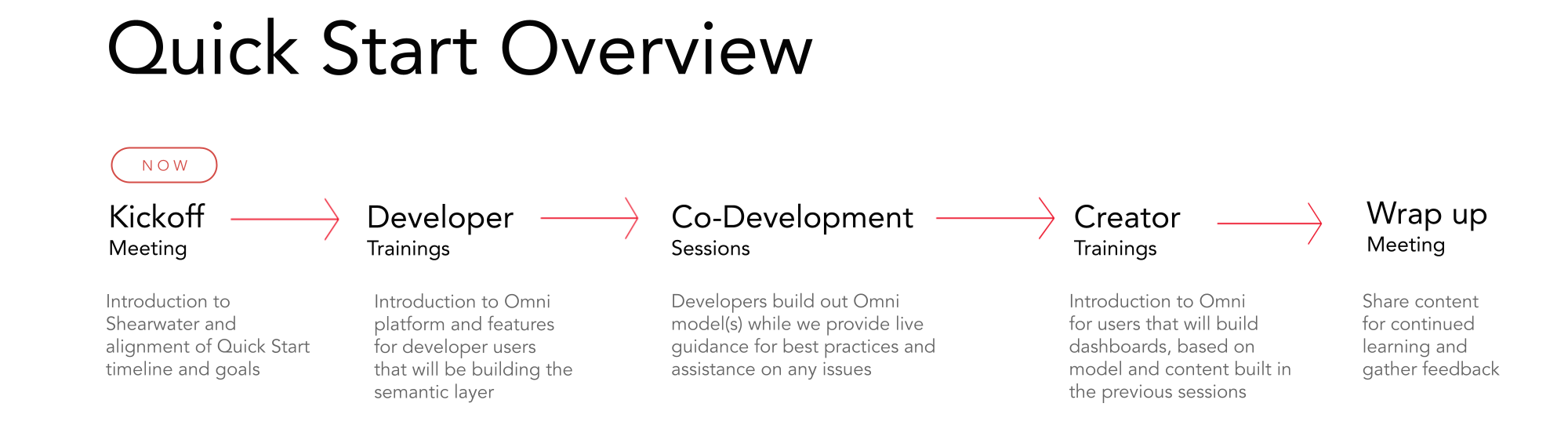
As a long-time and trusted Omni partner, Shearwater led the onboarding process at Instrumentl and played a critical role in accelerating adoption, by providing:
- Clear explanations and strong platform expertise
- Effective knowledge transfer
- Guidance on best practices for modeling, governance, and adoption
Adoption progressed faster than expected, and users reported a positive experience.” — Zach Sugano, Senior Software Engineer
The Impact of Omni Adoption at Instrumentl
Instrumentl began seeing meaningful impact very quickly following the adoption of Omni, with new users growing approximately 15% week over week, generating thousands of queries.
Despite having a data engineering team of just one person, Instrumentl has already built 60+ dashboards since adopting Omni, supporting teams across Finance, Sales, Customer Success, Marketing, Product, and Engineering.
Time spent responding to ad-hoc data requests has been significantly reduced. Many questions that previously required manual work or direct engineering involvement can now be answered directly in Omni with little to no support.
In addition, visibility into trusted data has improved substantially, and several reports that were previously run manually are now automatically delivered through scheduled emails.
These outcomes highlight the progress Instrumentl has made, evolving from limited data access to growing adoption and data-driven decision-making that continues to expand week over week.
-
Ready to modernize your analytics stack?
If, like Instrumentl, you are looking to expand self-service analytics, introduce AI into decision-making, and build a scalable BI foundation, it may be time to partner with specialized support.
👉 Connect with Shearwater and discover how we can help you unlock the full potential of your data and accelerate real business impact.